

What to Wear Under a Jumper Without Adding Bulk
The secret to comfortable autumn and winter layering is not simply adding more clothes. It is choosing the right first layer.
A good base layer should be:
- soft enough to wear directly against the skin
- fine enough to sit smoothly under knitwear
- fitted enough not to bunch
- comfortable enough to wear for hours
- presentable enough to wear on its own if you remove the jumper
That last point matters. For everyday life, most women do not want to wear a technical thermal underneath a jumper if they might later take that jumper off at work, in a restaurant or at home. A premium T-shirt can often solve the problem much more elegantly.
So if you are wondering what to wear under a jumper without adding bulk, here is what to look for.
Start with a fine base layer

The first rule of low-bulk layering is simple: do not put a heavy layer underneath another heavy layer.
A thick cotton T-shirt underneath chunky knitwear can quickly create too much volume around the shoulders, arms, waist and underarms. That can make the jumper sit differently and may feel restrictive.
A finer base layer usually works better. Look for a top that sits relatively close to the body and has enough softness and stretch to move with you. For many women, cotton-modal or modal-based fabrics are especially useful because they tend to feel smoother and more fluid than heavier, more structured jersey.
Why cotton-modal works well under knitwear
Cotton-modal is particularly well suited to layering because it combines softness, smoothness, fluid drape, comfort and relatively low bulk. That makes it a useful option underneath wool jumpers, cashmere, cardigans, fine knits and heavier winter knitwear.
At Lavender Hill Clothing, cotton-modal is used across many of our core T-shirt styles because the same top needs to work both on its own and underneath other garments. That versatility is particularly valuable in autumn and winter.
Match the neckline to the jumper
A layering top does not only need the right fabric. The neckline matters too. Ideally, you want the T-shirt neckline either to sit neatly underneath the jumper or show deliberately. What you want to avoid is an awkward edge appearing unpredictably.
What to wear under a crew-neck jumper
You have two good options.
A scoop neck underneath. A scoop neck will usually sit below the jumper neckline and remain mostly hidden. This is useful if you want a clean finish, no visible base layer and more softness around the neckline. Try the Long Sleeve Scoop Neck T-Shirt.
A crew neck underneath. A crew-neck T-shirt can show slightly at the collar for a deliberate layered effect. This works particularly well as a white T-shirt under a navy jumper, or a white T-shirt under grey knitwear. The small contrast at the neckline can make the outfit feel more considered. Try the Long Sleeve Crew Neck T-shirt.
What to wear under a V-neck jumper
A V-neck jumper usually works best with a V-neck or scoop-neck T-shirt, as both follow the open shape of the knitwear naturally. A crew neck can also work if you intentionally want the T-shirt to show, but it creates a much more obvious layered look. If you want the base layer to disappear, choose the lower neckline. Try the Long Sleeve V Neck T-shirt.
What to wear under a cardigan
Cardigans give you more freedom because the layer underneath remains visible. That means you can choose a crew neck, scoop neck, V-neck, mock neck or roll neck according to the outfit rather than simply trying to conceal the base layer. A cardigan is one of the easiest ways to use a T-shirt as both a practical layer and a visible part of the outfit. See our full guide to what to wear under a cardigan.
Choose long sleeves if wool irritates your skin
If wool feels itchy, a short-sleeve T-shirt may not solve the problem. Your torso is protected, but the knitwear still touches your arms. A long-sleeve base layer creates a barrier between the knit and your torso, shoulders and arms, which can make wool or cashmere significantly more comfortable.
A fine, soft long-sleeve T-shirt is particularly useful because it provides coverage without making the sleeves of the jumper feel tight.
The best long-sleeve layer should not feel like a thermal
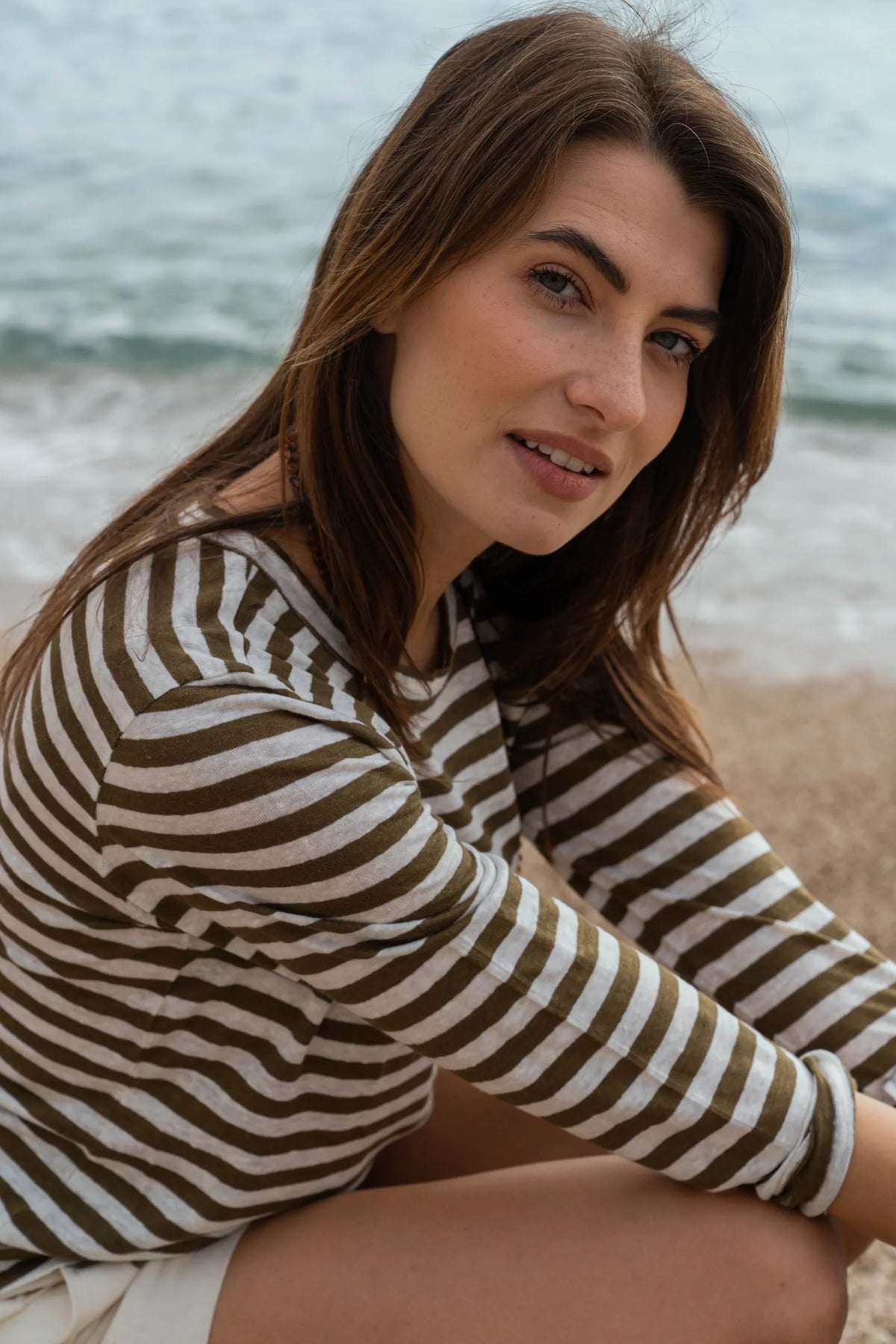
For everyday dressing, look for something that could still function as a proper top: a neat neckline, a flattering fit, clean finishing and a fabric you would happily wear alone. Our long sleeve collection is designed in exactly this way. The pieces can sit under knitwear, but they are not intended to feel like hidden underwear.
Try three-quarter sleeves in milder weather
You do not always need a full long sleeve. Three-quarter sleeves can be an excellent compromise in late summer, early autumn, spring and on mild winter days indoors. They give more coverage than a short sleeve but less warmth and bulk than a full-length arm, which is useful under cardigans, lightweight jumpers and jackets. If you tend to push long sleeves up anyway, a three-quarter sleeve may be more comfortable.
Short sleeves can still work under jumpers
A short-sleeve T-shirt remains useful if the jumper itself is soft, you do not need protection from wool, you tend to feel warm, the weather is mild, or you want less fabric through the arms.
This is why there is no single “correct” base layer. The right sleeve length depends on temperature, fabric, comfort and the outer garment.
Consider a mock neck under knitwear

A mock neck can work beautifully underneath crew-neck jumpers, cardigans, sleeveless knits and jackets. It provides extra coverage around the neck without the full height and fold of a roll neck. This can be particularly useful if you like a higher neckline, want more warmth, or dislike the bulk of a traditional roll neck. A fine mock neck also creates a polished autumn and winter silhouette.
What about a roll neck under a jumper?
A roll neck can work very well under V-neck knitwear, cardigans, sleeveless jumpers and looser crew-neck knits, where the higher neckline becomes a visible styling feature. A fine roll neck, such as our Roll Neck Micro Modal Top, is much easier to layer than a thick knitted one because it adds warmth without creating too much volume around the neck and shoulders.
Avoid excessive fabric through the body
One of the biggest causes of bulk is not thickness. It is excess fabric. A T-shirt that is too loose may bunch around the waist, lower back, underarms and sides once the jumper is added.
That does not mean the base layer should be skin-tight. It simply needs to sit smoothly. A useful test is to put the T-shirt on and run your hands over the sides. If there is a large amount of loose fabric, it may not be the best layering piece.
Body length matters too
A very long T-shirt can create unnecessary bulk around the waist, especially if you tuck it into trousers, wear high-waisted jeans or wear a shorter jumper. Think about the length of both garments together. If the jumper is cropped or waist length, an excessively long base layer may show underneath unless that is intentional. If you tuck the T-shirt in, choose one long enough to stay secure without creating lots of folded fabric.
Should you tuck your base layer in?
Sometimes. Tucking can help keep the T-shirt smooth, stop it riding up and reduce visible bunching. It can be particularly useful under fitted knitwear, short jumpers and blazers. However, if the T-shirt is already long and the trousers are high-waisted, tucking too much fabric can create bulk. The solution is usually not a special technique: it is choosing the right body length in the first place.
Look for flat, comfortable seams
Seams that feel fine on their own can become uncomfortable once a jumper presses them against the skin. Pay particular attention to shoulder seams, underarms and side seams. If these areas feel thick or rough, they may become irritating after several hours. For a base layer, comfort in construction matters almost as much as fabric softness.
Fine does not have to mean see-through
A layering T-shirt does not need to be heavy, but it should still feel like a proper garment. Fine fabric can offer good coverage if it is densely constructed, well made and correctly fitted. This matters if you take the jumper off: a good layering top should not suddenly feel like underwear.
Why your base layer should look good on its own
This is one of the most practical differences between everyday layering and technical outdoor layering. You might remove your jumper at work, on public transport, in a restaurant, in a warm shop or at home. The T-shirt underneath should still create a complete outfit, so pay attention to neckline, fit, colour, opacity and sleeve length.
At Lavender Hill, layering pieces are designed as wardrobe garments first, not hidden thermals. That gives them much more year-round use.
What colour should you wear under a jumper?
You have two choices: hide the base layer or use it as contrast.
- To hide it: choose a similar colour to the jumper, such as navy under navy or black under black. This keeps the outfit visually clean.
- For contrast: try white under navy, cream under chocolate, black under camel or pale blue under navy. A small amount of colour at the neckline can make simple knitwear look more styled.
Under a white or cream jumper
Lighter knitwear can reveal more of the layer underneath. Choose white, cream, a tone close to your skin or a very pale neutral, depending on the opacity of the jumper. Avoid a very high-contrast dark T-shirt under a fine light knit unless you deliberately want that effect.
Under a dark jumper
Dark knitwear is much easier. You can use white for contrast, navy, black, cream or colour. If the T-shirt neckline will show, choose a shade that feels deliberate.
Layering under different jumper shapes
Under a fitted jumper
With fitted knitwear, every extra fold becomes noticeable. Choose fine fabric, a close fit, minimal excess length, smooth seams and the right neckline. A fitted long-sleeve cotton-modal T-shirt can work especially well here. Avoid oversized T-shirts underneath fitted jumpers.
Under an oversized jumper
You have more room with oversized knitwear. You can choose a slightly more relaxed base layer, but still avoid unnecessary bulk. A longer T-shirt can also be allowed to show at the hem if that is part of the styling. The key is intentional proportion.
Under chunky knitwear
Chunky knits already create a lot of volume, so the layer underneath should generally be very simple: fine jersey, soft fabric, a close fit and minimal detailing. This keeps the outfit comfortable and prevents the arms and shoulders feeling overloaded.
How to stay warm without adding bulk

Warmth comes from trapped air between layers, not simply from wearing one enormous garment. A useful formula is:
fine base layer + knitwear + coat
This gives you three layers without creating excessive volume. For colder weather, a long-sleeve base + fine knit + coat may feel much easier to wear than a thick sweatshirt + chunky jumper + heavy coat.
What is the best base layer if you do not like wool?
If you avoid wool completely, you can still create warmth through layering. Try cotton-modal long sleeves, micro modal tops, fine jersey mock necks and soft roll necks, then add a cardigan or non-wool outer layer. You do not need wool to use the layering principle effectively. See the best base layers for women who don't like wool.
T-shirt vs vest under a jumper
A vest is useful if you want almost no bulk in the arms, a base layer through the torso only, and less warmth. A T-shirt provides more coverage, a more presentable standalone top and more protection from knitwear. For wool jumpers, a long-sleeve T-shirt usually provides the most complete barrier.
T-shirt vs shirt under a jumper
A shirt creates a more structured look but usually adds more bulk because of its collar, cuffs, placket and woven fabric. A T-shirt gives a cleaner, softer layer. Choose a shirt if you want the collar and cuffs to become part of the outfit; choose a T-shirt if comfort and low bulk are the priority.
Base layer vs thermal top
Technical thermal tops are designed primarily for warmth. They are excellent for outdoor activity, very cold conditions, skiing and walking. For normal everyday dressing, however, you may not need that level of insulation. A premium T-shirt can be more versatile because you can wear it both under a jumper and on its own.
What to wear under a jumper at work
For work, the base layer should look polished enough to stand alone. Useful options include:
- crew neck with tailored trousers
- V-neck with a blazer
- mock neck with wide-leg trousers
- long-sleeve scoop with a cardigan
Choose a neutral or sophisticated colour and keep the fabric smooth and understated.
What to wear under a jumper when travelling
Layering is especially useful for travel because temperatures can change quickly. Try a soft T-shirt + cardigan or jumper + jacket, which lets you adjust without needing to change outfits. A cotton-modal base is useful because comfort matters when you are wearing the same clothes for several hours.
A simple low-bulk layering wardrobe
You do not need a huge number of specialist pieces. A practical set might include:
- 1 white short-sleeve T-shirt
- 1 navy three-quarter-sleeve T-shirt
- 1 black long-sleeve T-shirt
- 1 cream or navy roll neck
Those four can work underneath a wide range of knitwear.
The best tops to wear under jumpers
- Best for everyday layering: a fine cotton-modal T-shirt
- Best if wool irritates you: a long-sleeve cotton-modal top
- Best for milder weather: a three-quarter-sleeve T-shirt
- Best for extra neck warmth: a fine roll neck
- Best if you dislike roll necks: a mock neck
- Best if you run warm: a short-sleeve T-shirt
Why Lavender Hill T-shirts work well under knitwear
Lavender Hill Clothing has specialised in women’s T-shirts since 2013. Layering is a natural part of the collection because the range includes short, half, three-quarter and long sleeves, and mock, roll, crew, scoop and V necks. That allows you to choose the base layer according to the jumper, the temperature and your comfort.
Soft cotton-modal and modal-based fabrics also make many of these styles particularly well suited to wearing directly against the skin.
The easiest way to layer without bulk
If there is one rule to remember, it is this: keep the first layer fine, soft and smooth. Then let the jumper provide the warmth.
You do not need three bulky garments to stay comfortable. A carefully chosen T-shirt underneath knitwear can add warmth, improve comfort and make the jumper easier to wear, without changing the shape of the outfit. And if the room becomes too warm? Take the jumper off. The layer underneath should still look just as good.
FAQs
What should I wear under a jumper without adding bulk?
Choose a fine, soft T-shirt that sits relatively close to the body without feeling restrictive. Cotton-modal and modal-based fabrics can work particularly well because they feel smooth and create less bulk under knitwear.
What is the best top to wear under a wool jumper?
If wool irritates your skin, a soft long-sleeve T-shirt is one of the best options because it creates a barrier along the arms and torso while remaining relatively fine underneath the knit.
Is a T-shirt or vest better under a jumper?
A vest adds less warmth and bulk through the arms, while a T-shirt provides more coverage and works better as a standalone garment if you remove the jumper. The best choice depends on the temperature and how sensitive you are to the knitwear fabric.
What neckline should I wear under a crew-neck jumper?
A scoop neck can sit invisibly underneath a crew-neck jumper, while a crew-neck T-shirt can be allowed to show slightly for a deliberate layered effect.
What should I wear under a V-neck jumper?
A V-neck or scoop-neck T-shirt usually sits most naturally beneath a V-neck jumper. Choose the neckline according to whether you want the base layer hidden or visible.
Are long-sleeve T-shirts good under jumpers?
Yes. A fine long-sleeve T-shirt can add warmth and help protect the skin from itchy knitwear without adding excessive bulk.
Can I wear a roll neck under a jumper?
Yes. A fine roll neck works particularly well underneath V-neck knits, cardigans and sleeveless jumpers. Choose a lightweight fabric so the neckline does not become too bulky.
Why are Lavender Hill T-shirts useful for layering under knitwear?
Lavender Hill Clothing offers soft T-shirts across multiple sleeve lengths and necklines, including long sleeves, three-quarter sleeves, mock necks and roll necks. This makes it easier to choose a fine base layer that works with the specific jumper and temperature.