




The History of the T-Shirt: From Navy Undershirt to Wardrobe Essential

The T-shirt began as underwear. It grew out of the cut-down union suits worn by workers and servicemen in the late 1800s, became official US Navy issue in 1913, got its name in print in 1920, and only became acceptable as outerwear after Hollywood put it on screen in the 1950s. Since then it has been a uniform, a protest banner, an advertising board and, today, one of the most worn garments in the world.
Here is how it happened, decade by decade.
The T-shirt at a glance
| Date | Moment |
|---|---|
| Late 1800s | Workers and soldiers cut one-piece union suits in half to keep cool; buttonless pullover undershirts follow |
| 1913 | The US Navy adopts a white, short-sleeved, crew-neck cotton undershirt as standard issue |
| 1920 | F. Scott Fitzgerald uses the word “T-shirt” in print in This Side of Paradise |
| 1930s | American retailers start selling the T-shirt as both an undershirt and an outershirt |
| 1940s | Millions of servicemen wear T-shirts in the Second World War and bring the habit home |
| 1951–1955 | Marlon Brando (A Streetcar Named Desire, 1951) and James Dean (Rebel Without a Cause, 1955) make the plain white T-shirt cool |
| 1960s | New inks and screen-printing machines make the printed T-shirt cheap to produce; tie-dye and protest slogans follow |
| 1970s | Band T-shirts, advertising tees and Milton Glaser’s “I ♥ NY” (1977) |
| 1980s | Slogan T-shirts go political: Katharine Hamnett meets Margaret Thatcher in one in 1984 |
| 1990s to today | The plain, well-made T-shirt becomes a wardrobe essential in its own right |
Before the T-shirt: union suits and undershirts
In the late nineteenth century, many working men wore a union suit: a one-piece undergarment covering the body from wrists to ankles. In hot conditions, workers and soldiers took to cutting them in half, and manufacturers began making separate, buttonless pullover undershirts in knitted cotton. They were cheap, easy to wash and needed no sewing on of buttons.
1913: the US Navy makes it official
The T-shirt’s real starting point is 1913, when the US Navy adopted a white, short-sleeved, crew-neck cotton undershirt as part of its standard uniform. It was light, quick to dry and practical below deck or in hot climates, where sailors often worked in the undershirt alone. The Army followed, and soldiers in the First World War wore similar undershirts.
1920: the word “T-shirt” appears in print
The first known use of the word “T-shirt” in print is in F. Scott Fitzgerald’s 1920 novel This Side of Paradise, where it appears in a list of the clothes the hero takes to university. The name simply describes the garment’s shape when laid flat.
1930s and 1940s: from underwear to outerwear
Through the 1930s, American retailers began advertising the T-shirt as something you could wear on its own, not just underneath a shirt. The Second World War did the rest. Millions of servicemen wore T-shirts as part of their kit, they appeared in wartime photographs and magazine covers, and men returning home kept wearing them for work, sport and weekends.
The 1950s: Brando, Dean and the white T-shirt
The T-shirt became fashionable thanks to Hollywood. In 1951, Marlon Brando wore a fitted white T-shirt as Stanley Kowalski in A Streetcar Named Desire, and in 1953 he paired one with a leather jacket in The Wild One. In 1955, James Dean wore a white T-shirt with jeans and a red jacket in Rebel Without a Cause. Together they turned a plain undershirt into a symbol of youth and rebellion, and the white T-shirt and jeans became a look of their own.
The 1960s: print, protest and tie-dye

Screen printing on fabric was not new, but plastisol ink, introduced in the late 1950s, and better multi-colour printing machines in the 1960s made printed T-shirts quick and cheap to produce. The T-shirt became a medium for messages: political slogans, protest causes and, by the end of the decade, the tie-dye associated with the counterculture.
The 1970s: bands, brands and “I ♥ NY”
In the 1970s, the printed T-shirt became a way to show which band you followed, which team you supported or which brand you liked, and companies quickly saw its value as walking advertising. Milton Glaser’s “I ♥ NY” design of 1977 became one of the most copied graphics in history. In London, punk designers used T-shirts deliberately to provoke.
The 1980s: the slogan T-shirt goes political
British designer Katharine Hamnett made the oversized slogan T-shirt a fashion statement. In 1984 she famously met Prime Minister Margaret Thatcher at Downing Street wearing one printed with a message about nuclear missiles. Slogan T-shirts became a recognised way to make a point, and remain one today.
The 1990s to today: the T-shirt as a wardrobe essential
Since the 1990s, the plain T-shirt has moved firmly into the mainstream of good dressing. Designers and luxury labels made basic T-shirts part of their collections, and the idea of a well-made, simple T-shirt worn under a blazer or with tailored trousers became normal rather than casual.
Fabric has changed too. Alongside traditional cotton, many better T-shirts now use longer-fibre cottons such as Supima, and plant-based fibres such as modal and lyocell, for a softer feel, better drape and shape that lasts.
How to wear a T-shirt today

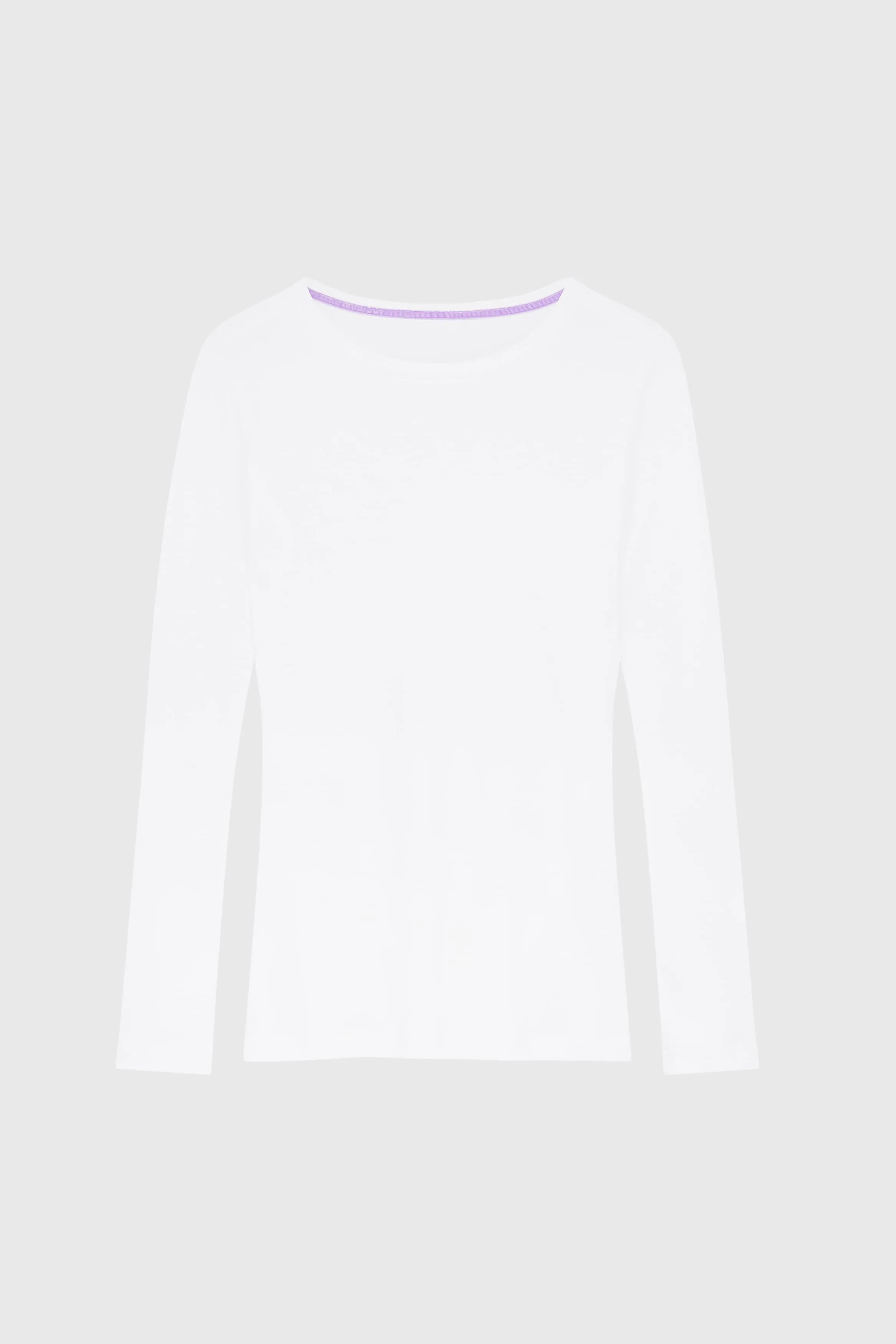
- The classic: a white T-shirt with straight-leg jeans, the look Brando and Dean made famous. Start with our white T-shirts.
- Smart: a fine crew or scoop neck under a blazer with tailored trousers. See tops to wear under a blazer.
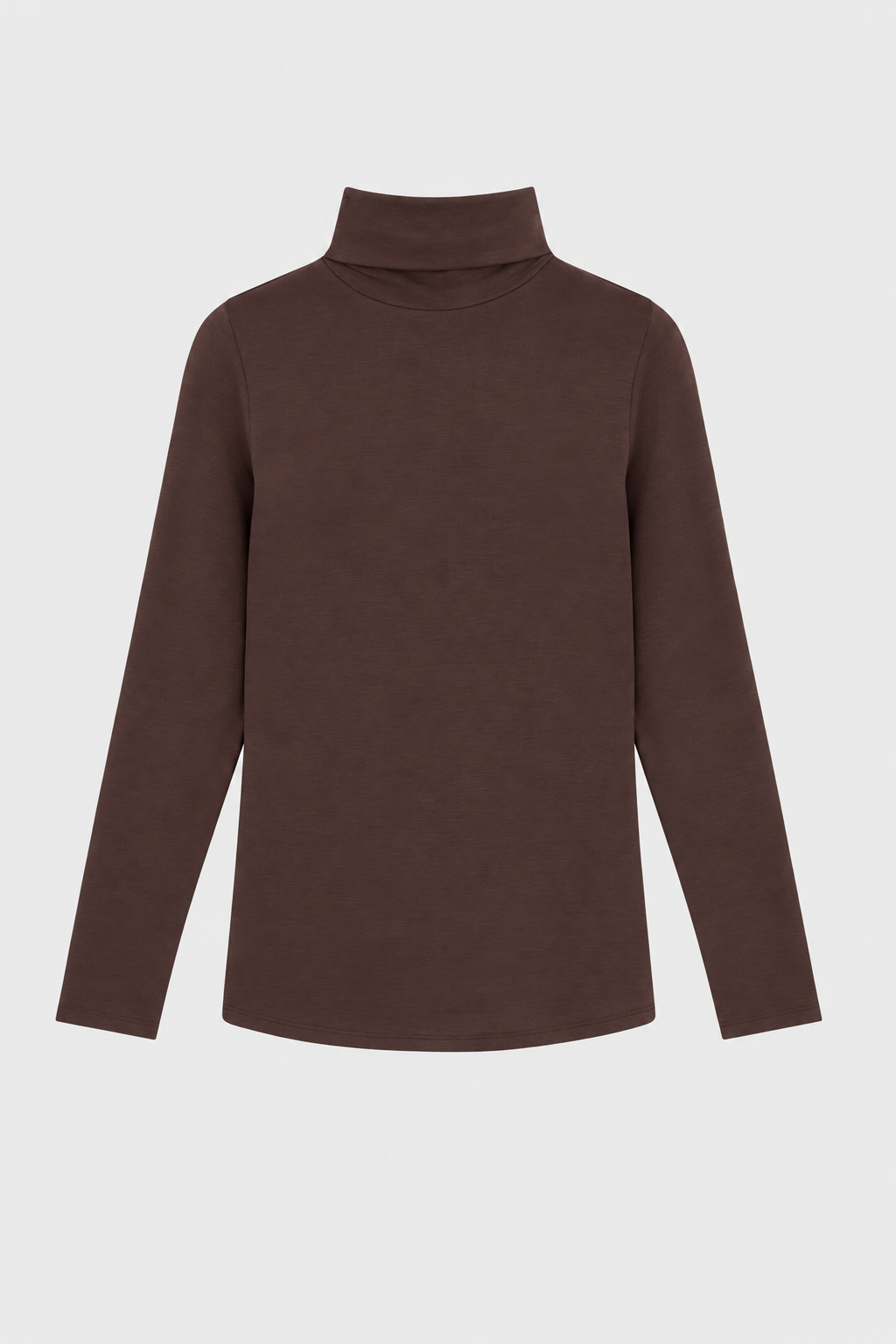
- Layered: a long sleeve T-shirt under a jumper or cardigan in colder months. See our long sleeve T-shirts.
- Nautical: a navy or striped T-shirt, a nod to the garment’s naval origins. See our navy T-shirts and striped T-shirts.
For more ideas, read our guides to women's T-shirt styles and what makes a T-shirt premium.
Frequently asked questions
When was the T-shirt invented?
Buttonless pullover undershirts developed in the late 1800s and early 1900s. The US Navy adopted a white, short-sleeved crew-neck undershirt as standard issue in 1913, which is usually taken as the start of the modern T-shirt.
Who first used the word “T-shirt”?
The first known use in print is in F. Scott Fitzgerald’s 1920 novel This Side of Paradise.
Why is it called a T-shirt?
Because of its shape: laid flat, the body and short sleeves form a letter T.
When did people start wearing T-shirts as outerwear?
Gradually from the 1930s, and much more after the Second World War. Marlon Brando in A Streetcar Named Desire (1951) and James Dean in Rebel Without a Cause (1955) made it fashionable.
When did printed T-shirts become popular?
In the 1960s, when new inks and screen-printing machines made printed T-shirts cheap to produce. They became a vehicle for slogans, bands and brands through the 1970s and 1980s.
Final thoughts
In little more than a century, the T-shirt has gone from naval underwear to one of the most versatile pieces in any wardrobe. The best ones today are simple, well cut and made from good fabric, so they look as right under a blazer as they do with jeans.
Explore our women's T-shirts, made from soft cotton modal and designed in Britain.